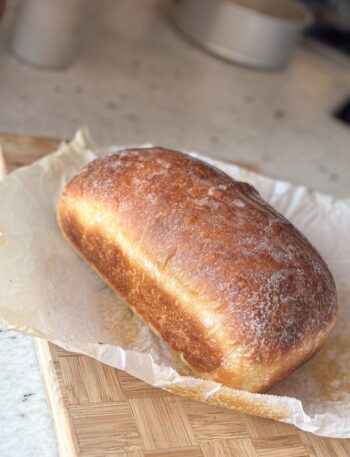
There is something truly special about a loaf of classic artisan sourdough bread. With its crisp golden crust, chewy interior, and distinctive tangy flavor, sourdough has been a beloved staple for centuries. Unlike breads made with commercial yeast, sourdough relies on a natural starter—a living culture of wild yeast and beneficial bacteria—to leaven the dough. This slow fermentation process develops complex flavors while improving texture and digestibility.
Making artisan sourdough bread at home may seem intimidating at first, but with patience and practice, anyone can create a bakery-quality loaf. This recipe focuses on traditional methods, allowing the natural fermentation process to work its magic.
Why You’ll Love This Recipe
- Crispy, crackling crust
- Soft and airy crumb with beautiful holes
- Naturally fermented for deeper flavor
- Made with simple ingredients
- No commercial yeast required
Ingredients
For the Dough
- 100 grams active sourdough starter
- 350 grams warm water
- 500 grams bread flour
- 10 grams fine sea salt
Equipment
- Large mixing bowl
- Bench scraper
- Proofing basket (banneton) or bowl lined with a towel
- Dutch oven with lid
- Parchment paper
- Sharp knife or bread lame
Step 1: Prepare the Dough
In a large mixing bowl, combine the active sourdough starter and warm water. Stir until the starter is mostly dissolved.
Add the bread flour and mix until no dry flour remains. The dough will look shaggy and rough. Cover the bowl with a damp towel and let it rest for 30 minutes. This stage is called the autolyse and helps hydrate the flour while improving gluten development.
After the rest period, sprinkle the salt over the dough. Mix thoroughly using your hands until the salt is fully incorporated.
Step 2: Bulk Fermentation
Cover the bowl and allow the dough to ferment at room temperature for 4 to 6 hours.
During the first 2 hours, perform a series of stretch-and-folds every 30 minutes:
- Wet your hands.
- Grab one side of the dough.
- Stretch it upward.
- Fold it over itself.
- Rotate the bowl and repeat on all four sides.
This technique strengthens the gluten structure without kneading.
As fermentation progresses, the dough will become smoother, puffier, and more elastic. It should increase in volume by about 50%.
Step 3: Shape the Dough
Lightly flour a work surface and gently turn out the dough.
Using a bench scraper, shape it into a loose round. Allow it to rest uncovered for 20 minutes.
After the rest, perform the final shaping:
- Stretch the edges toward the center.
- Flip the dough over.
- Use your hands to create surface tension by pulling the dough toward you on the counter.
A well-shaped loaf helps achieve excellent oven spring and a beautiful artisan appearance.
Step 4: Final Proof
Place the shaped dough seam-side up into a floured proofing basket.
Cover and refrigerate for 8 to 16 hours. This cold fermentation develops flavor and makes the dough easier to score before baking.
If you prefer, you can proof at room temperature for 2 to 3 hours, but the overnight refrigeration provides superior flavor and texture.
Step 5: Preheat the Oven
About 45 minutes before baking, place your Dutch oven inside the oven and preheat to 250°C (480°F).
A thoroughly heated Dutch oven creates steam, which helps develop the signature crust associated with artisan sourdough bread.
Step 6: Score and Bake
Carefully remove the hot Dutch oven.
Turn the dough onto a sheet of parchment paper. Using a sharp blade or bread lame, score the top with one long slash about 1 centimeter deep.
The score allows the bread to expand properly during baking.
Transfer the dough into the Dutch oven using the parchment paper.
Cover with the lid and bake for 20 minutes.
After 20 minutes:
- Remove the lid.
- Reduce the oven temperature to 230°C (445°F).
- Continue baking for 20 to 25 minutes.
The loaf should develop a deep golden-brown crust with rich caramelized color.
Step 7: Cool Completely
Remove the bread from the Dutch oven and place it on a wire rack.
Allow it to cool for at least 1 hour before slicing.
Although it can be tempting to cut into the loaf immediately, cooling allows the crumb to finish setting and prevents a gummy texture.
Tips for Success
Use an Active Starter
Your starter should be bubbly and doubled in size after feeding. An active starter is essential for proper fermentation and rise.
Be Patient
Sourdough fermentation depends on temperature and starter strength. If your kitchen is cool, fermentation may take longer than expected.
Don’t Over-Flour
Using excessive flour during shaping can make the dough difficult to seal and reduce its ability to rise properly.
Practice Scoring
A confident, swift slash helps the loaf expand beautifully during baking and creates an attractive artisan pattern.
Serving Suggestions
Classic artisan sourdough bread is incredibly versatile. Enjoy it:
- Toasted with butter and jam
- Alongside soups and stews
- As the base for gourmet sandwiches
- Dipped in olive oil and balsamic vinegar
- Served with cheese and charcuterie boards
Storage
Store the loaf at room temperature in a paper bag or bread box for up to 3 days.
For longer storage, slice and freeze the bread in airtight freezer bags for up to 3 months. Simply toast slices directly from frozen whenever needed.